
Before You Buy a New Sofa, Read This: When Reupholstery Is Actually Worth It
The old sofa might be better than the new one you're about to buy.was ready for another life.
We recently made the case for not furnishing your Hudson Valley house all at once.
Buy the mattress. Unpack the wine glasses. Live with the empty corners. Let the house tell you what it needs.
But there's another side to that conversation:
Before you replace the furniture you already have, make sure you know what you're getting rid of.
At Hudson Valley Upholstery, some of the least promising pieces that come through our doors turn out to be the ones I'm most excited about.
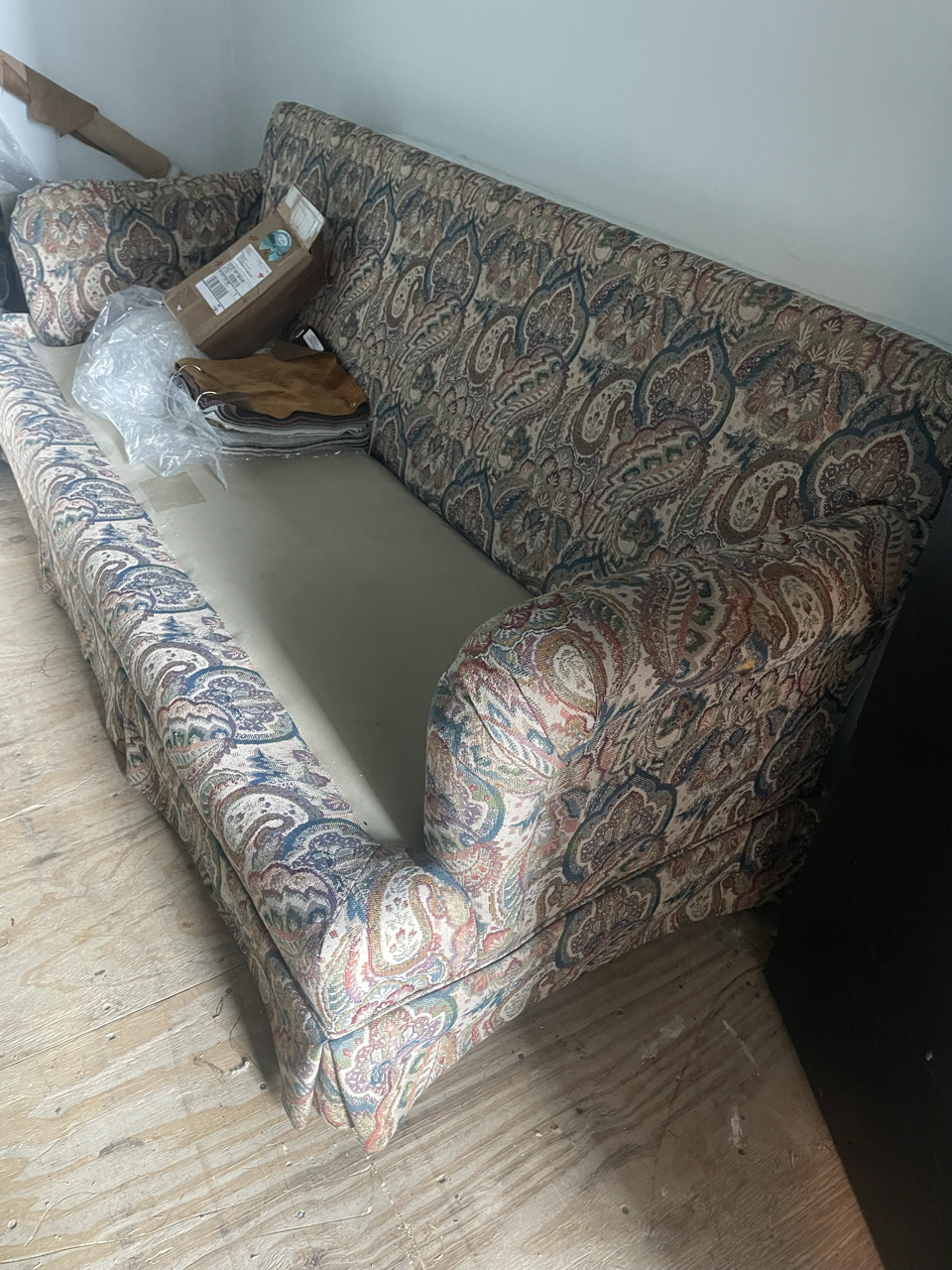
The fabric is faded. The cushions have collapsed. Something smells questionable. A cat has expressed herself artistically across one entire arm.
And then we start taking it apart.
Underneath all of that might be a solid hardwood frame, beautiful joinery, hand-tied springs or a piece of furniture built in a way that would be extraordinarily expensive to reproduce today.
Suddenly, that tired old sofa looks very different.
So before you spend a Saturday driving down Route 9 looking for its replacement—or order something online because it can be delivered next week (although, good luck with that) —here's how I think about whether a sofa is actually worth reupholstering.
First: Stop Looking at the Fabric
This is harder than it sounds.
Upholstery is the first thing you see, which means bad upholstery has an incredible ability to make good furniture look terrible.
Try to mentally remove it.
Ignore the dated stripe. Ignore the brown chenille. Ignore the floral that hasn't been fashionable since approximately 1987.
Look at the shape instead.
Do you like the proportions?
The curve of the arms?
The height of the back?
The exposed wood?
Does the sofa have a silhouette you haven't seen everywhere else?
If the answer is yes, keep looking.
We've had pieces arrive at the shop looking absolutely devastating that became some of my favorite projects once they were in the right fabric.
One chair in particular came to us looking especially sad. The client chose a very large-scale floral, and once we carefully centered the pattern across the chair, the entire personality of the piece changed.
It went from dowdy to grand.
That's one of the things I love most about upholstery.
You don't have to accept the previous owner's vision for the furniture.
Sometimes there's a wonderful piece hiding underneath somebody else's fabric choice.
Now Pick It Up
I mean this literally.
One of the easiest clues that you're dealing with substantial older furniture is weight.
Modern furniture can be constructed using engineered wood, particleboard, thinner components and other materials designed in part to make manufacturing and shipping more efficient.
Older upholstered furniture can be startlingly heavy.
That isn't a guarantee of quality, but it's a reason to investigate.
We're looking for things like solid hardwood framing, sturdy joinery, quality spring construction and components that can actually be repaired rather than simply discarded.
One of my favorite sofas we've ever reupholstered had the most incredible exposed wood frame. The curve in the wood came from a substantial solid piece, and the entire sofa was exceptionally heavy.
I'd never seen another one quite like it.
It was also sad.
And stinky.
And once we opened it up, we discovered a significant quantity of what I affectionately call couch croutons.
But that's the wonderful thing about reupholstery:
We're not preserving the couch croutons.
We can take a piece down to its bones.
Old padding can come out. Deteriorated foam can be replaced. Support can be addressed. Cushions can be rebuilt. And instead of covering all of those problems with something pretty, we can actually deal with what's underneath.
That sofa wasn't ready for the landfill.
It was ready for another life.
Is It Sentimental?
This might be the easiest question of all.
Sometimes the financial value of a piece doesn't matter very much.
Your grandmother sat in it.
It was the first sofa you bought when you got married.
Your kids grew up on it.
It came with the house, and somehow, over the years, it became part of the house.
I think we have a strange tendency to believe that sentimental furniture needs to remain exactly as we remember it in order to preserve the memory.
It doesn't.
You can change the fabric.
You can change the cushion fill.
You can make it comfortable again.
You can take something that looks a little sad and make yourself fall in love with it all over again.
You're not erasing its history.
You're adding to it.
Is It Mid-Century Modern? Don't Make Any Sudden Decisions.
Mid-century modern furniture is one category where I especially encourage people to look twice before getting rid of something.
Not every piece labeled “mid-century” is valuable, and an optimistic asking price online doesn't establish what a piece is actually worth.
But genuinely well-made mid-century modern furniture can be an excellent candidate for reupholstery.
Danish modern pieces are particularly worth investigating, as are sofas and chairs with distinctive exposed wood, chrome details, unusual proportions or construction you simply don't see very often anymore.
And sometimes you have to look past some damage.
One of our mid-century modern clients—we'll call her Sally—had a sofa with a wonderful shape and good bones.
It had also been extensively customized by her cats.
Sally referred to the damage as “the art the girls left.”
She referred to her cats as the girls.
I knew immediately that we were going to get along.
For that project, choosing fabric wasn't just about finding something beautiful.
We needed something appropriate for the girls.
That's something we talk about a lot at Hudson Valley Upholstery because the prettiest fabric in the showroom isn't necessarily the best fabric for your house.
Do you have pets?
Children?
Grandchildren?
Is this the sofa everyone piles onto during the weekend, or is it sitting in a room that's used three times a year?
Do you eat on it?
Does it get direct sunlight?
Are you someone who will be devastated by the first spot, or do you want a fabric that can take a little abuse?
These are all part of choosing upholstery fabric.
We prefer helping our clients source fabric through our workroom because we can guide them toward upholstery-grade materials from manufacturers and suppliers we trust. We can look at durability, fiber content, construction, cleanability, pattern repeat and intended use—not simply whether the color looks good on a screen.
Reupholstering a great sofa and putting the wrong fabric on it doesn't make much sense.
The goal is to make the whole piece last.
But Is Reupholstery Cheaper Than Buying New?
Sometimes.
But that's not really the question I want you to ask.
You can absolutely find a new sofa for less than the cost of professionally rebuilding and reupholstering an older one.
You can also find a new sofa that costs considerably more.
There is such an enormous range in new furniture that comparing “new versus reupholstered” strictly by price isn't particularly useful.
The better comparison is:
What would it cost to buy a new sofa of comparable construction, character and materials?
That's where the equation starts to change.
Professional reupholstery involves labor. A sofa may need to be stripped, repaired, rebuilt, padded, fitted and upholstered. There may be new foam, batting, springs or other materials involved. Then there's the upholstery fabric itself.
It's an investment.
But if the piece underneath is exceptional, you're investing in something you already know fits your room, something that may have significantly better bones than many readily available replacements, and something you get to make completely your own.
That's very different from simply putting new fabric over an old sofa.
Sometimes We Will Tell You Not to Reupholster It
This is important.
Not every sofa deserves saving.
If the underlying construction is poor, the frame has significant problems, the proportions don't work for you, you find the sofa fundamentally uncomfortable, and there's no sentimental or design reason you're attached to it, the money may be better spent elsewhere.
Reupholstery can't make you love a shape you've always hated.
And if you bought a sofa six months ago and already dislike how it sits, I'd want to understand why before recommending that you invest substantially more money into it.
Sometimes the answer really is:
Buy another sofa.
We'd rather tell you that than take on a project that doesn't make sense.
Then There Are the Sofas You Couldn't Buy Again If You Tried
These are my favorites.
They're usually the ones where you start noticing details.
A beautiful curve in the frame.
A strange little leg.
The perfect proportions for an old room.
A silhouette nobody seems to manufacture anymore.
Or maybe it isn't particularly valuable or pedigreed at all.
It's simply yours.
For the solid-wood-frame sofa I mentioned earlier, the client trusted us enough to have some fun.
She couldn't settle on just one fabric for the cushions.
So we didn't make her.
We upholstered one side in one fabric and the reverse in another.
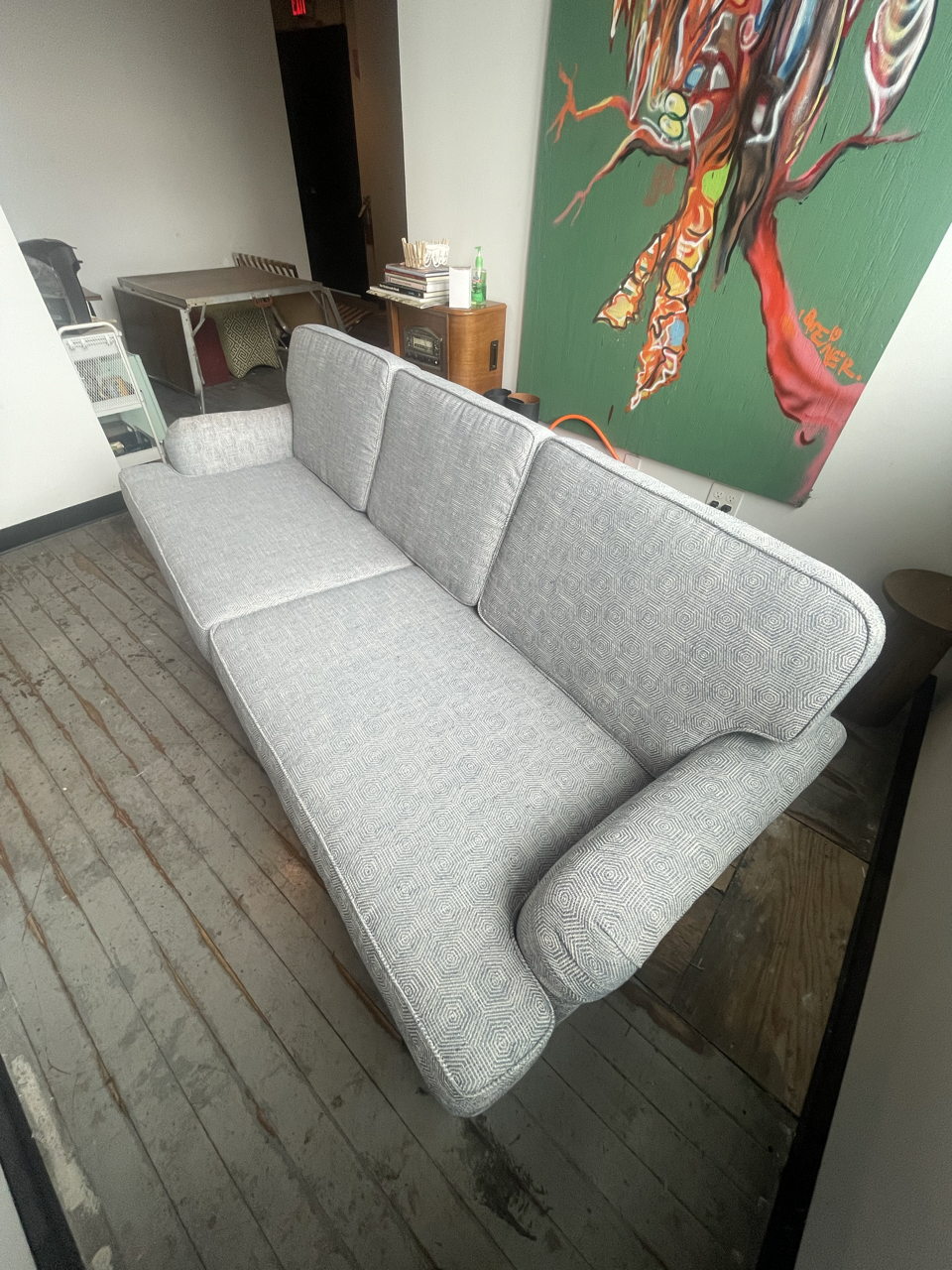
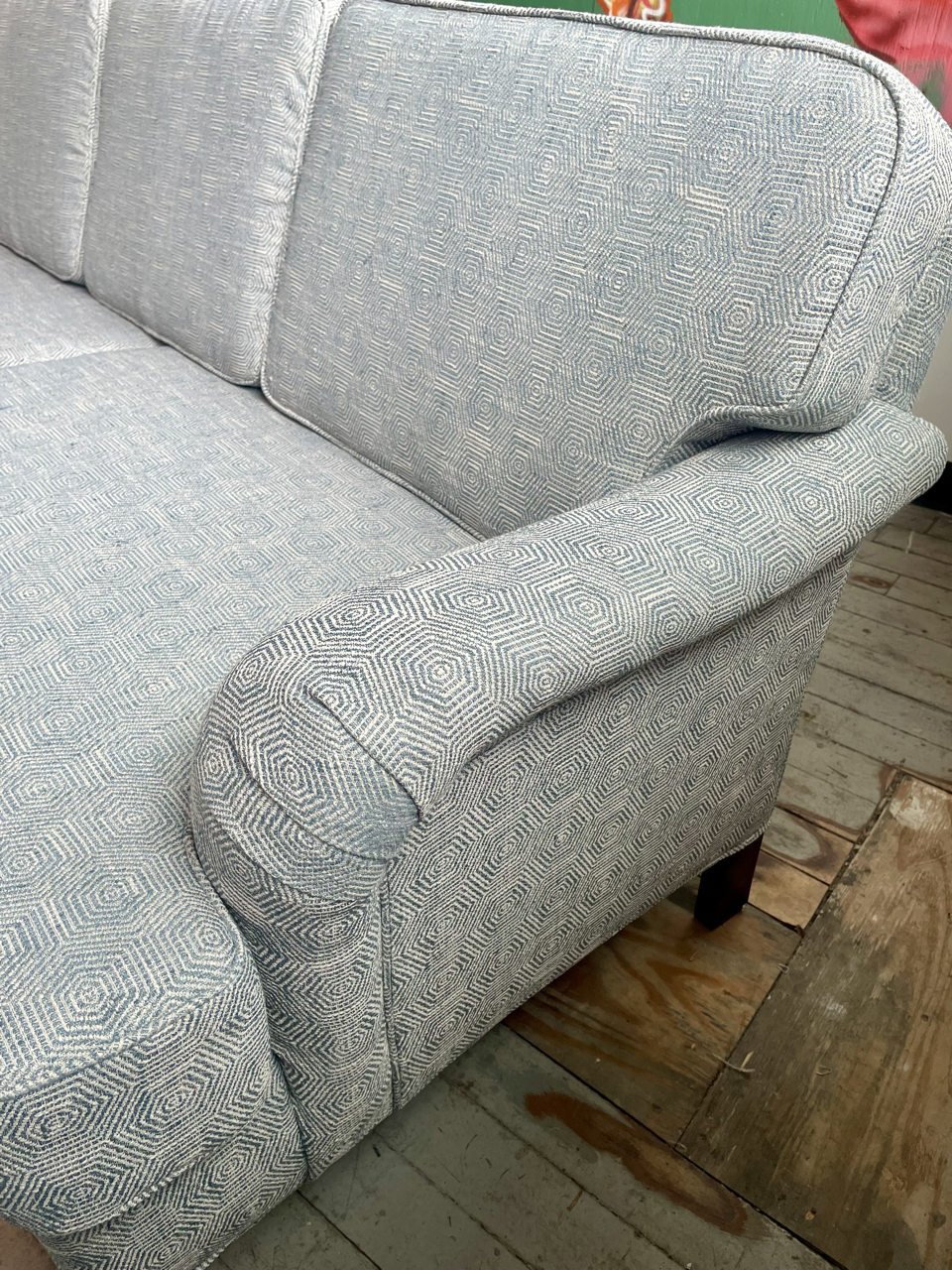
Depending on her mood, she can flip them.
That's the other part of the new-versus-old equation that doesn't fit neatly into a spreadsheet.
When you reupholster something, you're not limited to choosing Sofa A in Beige, Blue or Gray.
We can talk about welt. Cushion construction. Pattern placement. Contrasting fabrics. Trim. Fill. Performance. Details that make sense specifically for you.
You get to participate.
Your Upstate House Doesn't Need Another Placeholder
In our piece, So You Bought a House Upstate. Please Don't Furnish It All at Once, I wrote about resisting the urge to solve every empty corner immediately.
This is the companion rule:
Don't get rid of everything immediately, either.
That sofa from your city apartment may look completely different against the old plaster walls of your Hudson Valley house.
The strange chair you inherited might finally make sense next to the fireplace.
The mid-century sofa covered in cat art might be considerably better furniture than the replacement sitting in your online shopping cart.
Live with it.
Look underneath it.
Have someone who knows furniture take a look at it.
And then decide.
Because the goal isn't to preserve old furniture simply because it's old.
It's to recognize the good stuff before it's gone.
Furniture Should Get Better With Your Life
One of the best parts of what we do at Hudson Valley Upholstery is seeing a finished piece again after it has left the shop.
When it leaves us, everything is perfect.
The fabric is pristine. The cushions are arranged. Nobody has spilled anything. The cat hasn't even had an opportunity to critique our work yet.
Then I see it months later.
Someone's curled up in the corner.
The grandkids have claimed it.
There are books on the cushion and a glass on the table beside it.
The girls are back.
That's when the project actually feels finished to me.
Furniture isn't meant to remain perfect.
It's meant to be good enough to live with you for a very long time.
So before you replace the old sofa, take another look.
Ignore the fabric.
Check the bones.
Remember where it came from.
Think about what it could become.
And if it's good furniture?
