
So You Bought a House Upstate. Please Don’t Furnish It All at Once.
On empty corners, old furniture, custom banquettes, and letting your Hudson Valley home tell you what it needs.
There’s a particular temptation that comes with buying a house upstate.
You get the keys, and suddenly every empty room feels like a problem that needs to be solved.
You need a sofa. You need the dining table. You need something under that window. You need six chairs, two nightstands, a bench for the mudroom and whatever piece of furniture Pinterest has convinced you belongs at the end of the bed.
My advice?
Buy the mattress.
Then give it a minute.
Some of the best decisions you’ll make for a home happen after you’ve lived in it long enough to realize that the room you thought would be the formal dining room is where nobody ever sits or that one awkward corner of the kitchen is somehow where everyone ends up drinking coffee on Sunday morning.
The best homes, in my opinion, aren’t furnished all at once. They’re collected.
And sometimes the house has better ideas than you do.
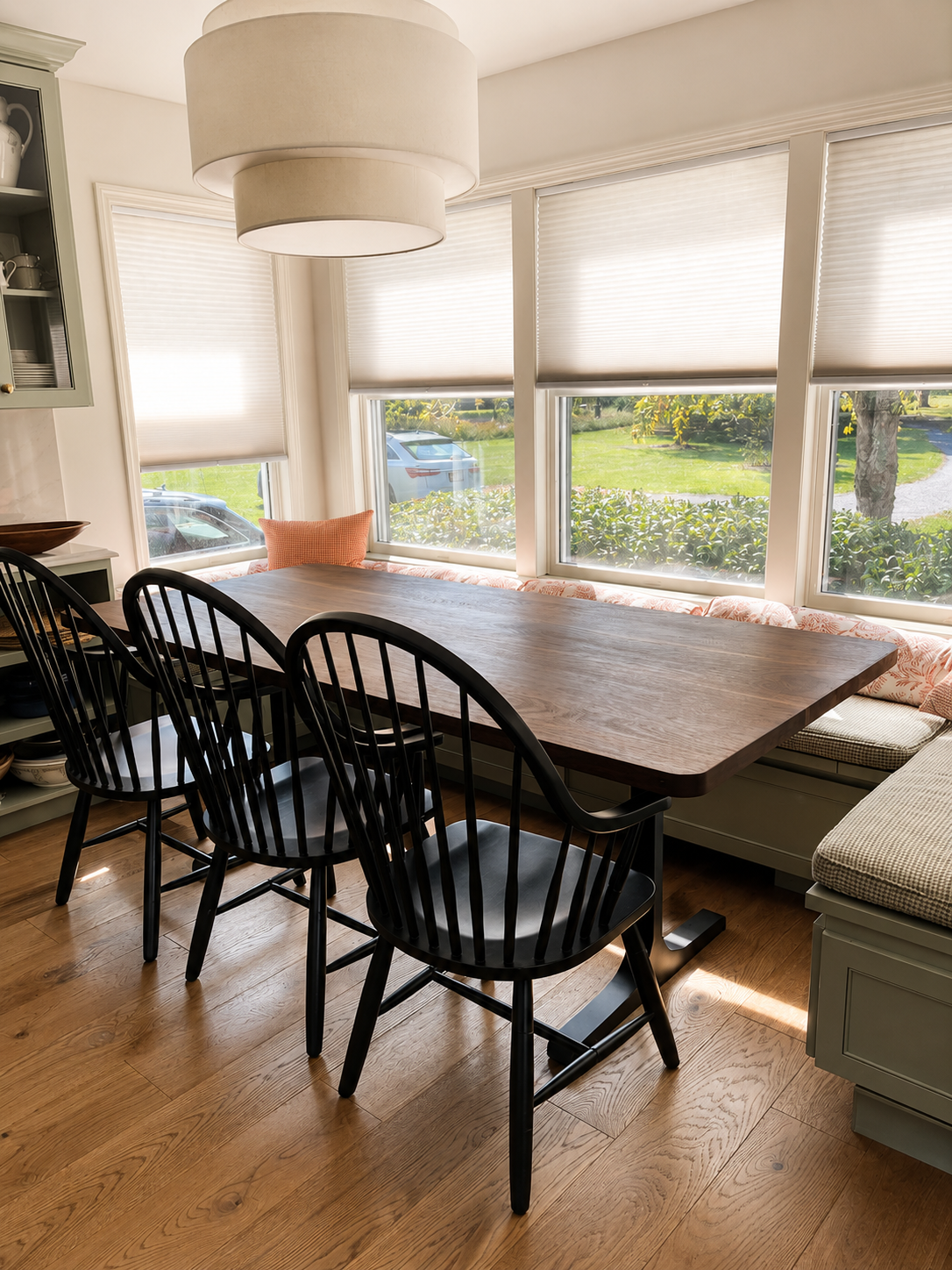
Have a Vision. Just Know That the House May Change It.
One of my clients—we’ll call her Debbie—bought a second home here in the Hudson Valley and knew almost immediately what she wanted: a big, beautiful custom built-in banquette.
The floors weren’t even down yet. The kitchen cabinets weren’t installed.
But the banquette? She could see it.
And I completely understood.
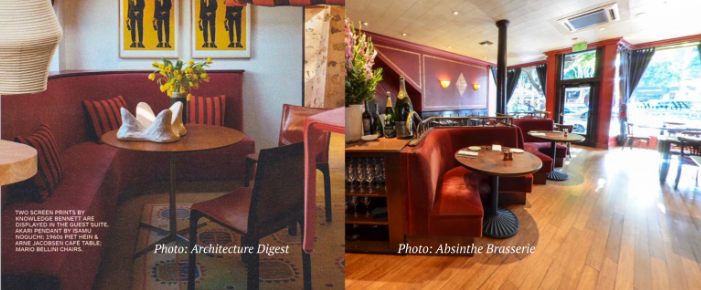
Years ago, I worked for two years at Absinthe, a French brasserie in San Francisco. It was one of those restaurants where the atmosphere was as important as what was on the plate. Red velvet. Plush banquettes. Cozy seating. The entire restaurant made you want to settle in and stay awhile.
I’ve dreamed about having that kind of banquette in my own home ever since.
So when Debbie sent me her inspiration photos, I immediately sent her a photo of Absinthe.
I know exactly what you’re trying to do.
Her vision was so close to the room I’d carried around in my own head for years that I was thrilled to get to build it for her. I might not have had the house for my dream banquette yet, but I could help someone else have hers.
There was only one problem.
The house wasn’t finished yet.
Measurements changed as floors went down and cabinetry went in. And when you’re making something custom, a few inches aren’t necessarily a few inches. They can mean redesigning, remeasuring and spending more time and money than anyone planned.
So I’m certainly not going to tell you to stop dreaming about the banquette before the kitchen exists.
I will tell you to wait before we cut the foam.
Sometimes Waiting 20 Years Doesn’t Solve Everything, Either.
I have another set of clients who have been spending weekends at their home in Gardiner for more than 20 years.
They had been dreaming about renovating their kitchen for ages. Finally, it happened. New kitchen. New breakfast nook. And then it was time for the upholstery.
The built-in bench had already been constructed at about 19 inches high.
That’s pretty much dining height before we’ve added a cushion.
I secretly wanted a gloriously thick, plush cushion for them. The architecture disagreed.
We needed to keep the seat cushion relatively thin, so instead I suggested adding long, feather-filled bolster pillows along the back of the nook.
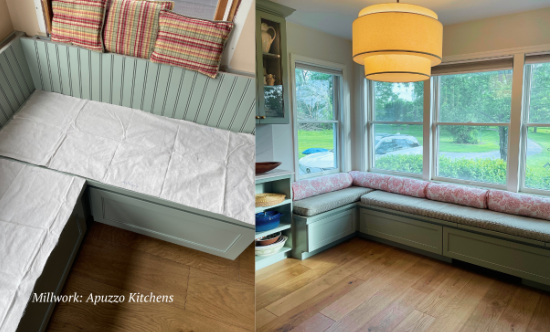
The bolsters gave us back some of the softness and luxury that we couldn’t put into the seat itself—and ultimately made the whole thing look much more custom.
I’ve developed a rule from projects like this:
If the architecture forces you into a thinner cushion, find somewhere else to bring in the plushness.
And if you’re having a banquette or breakfast nook built from scratch, bring your upholsterer into the conversation before the carpenter finishes it.
We think about things like finished seat height, foam thickness, fabric, how cushions will sit against each other, and whether you’ll actually be comfortable lingering there over another glass of wine.
Those decisions are much easier to make before the cabinetry is permanently attached to your house.
Good Bones Apply to Furniture, Too.
The same patience applies to the furniture you already own.
Something doesn’t necessarily need to leave your house because the fabric is tired, stained, dated—or has been subjected to some unauthorized customization.
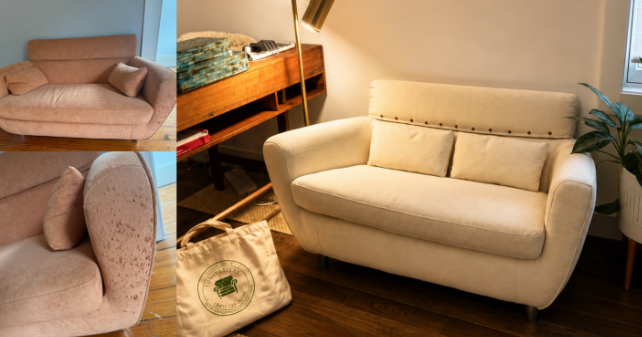
One of my favorite mid-century modern sofa clients affectionately referred to the damage her cats had done as “the art the girls left.”
She called the cats the girls.
I knew we were going to get along.
The sofa itself had a fantastic shape and good bones. There was absolutely no reason to give up on it.
Our job wasn’t simply to make it look new. We needed to find upholstery fabric worthy of the sofa—and appropriate for life with the girls.
That’s an important distinction.
Your house isn’t a photograph.
Your furniture needs to survive the people, pets, grandchildren, dinner parties, muddy weekends and Sunday afternoons that actually happen there.
We’ve had other pieces arrive at the shop looking, frankly, devastating.
One chair in particular didn’t look like much when it came through our doors. But I could see the shape underneath everything that was wrong with it.
The client chose a huge floral.
Not a safe little print. A proper, large-scale floral.
We carefully centered the pattern on the chair and suddenly this sad old piece became grand. It was no longer furniture that quietly filled a corner.
It was the corner.
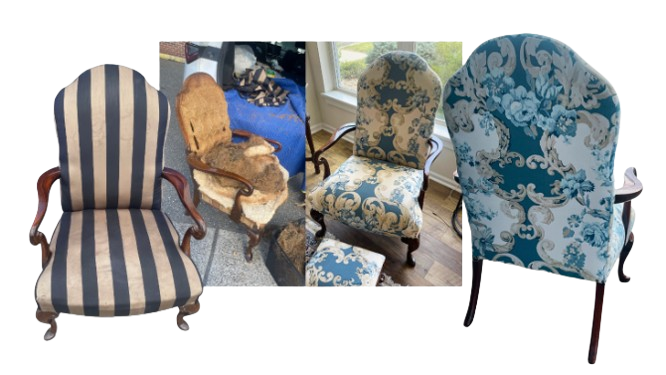
Sometimes the thing you think needs replacing just needs somebody to see what it could be.
Go Hunting Before You Go Shopping.
I learned upholstery on furniture nobody wanted.
When I first started, I would find free pieces on Facebook Marketplace and use them as learning projects.
And I have a thing for banquettes.
So when I saw a free banquette listed about 45 minutes away one rainy night, naturally I went to get it.
It was crusty.
It was also free.
This seemed like a perfectly reasonable arrangement.
That crusty bench then sat untouched in our upholstery shop for more than a year.
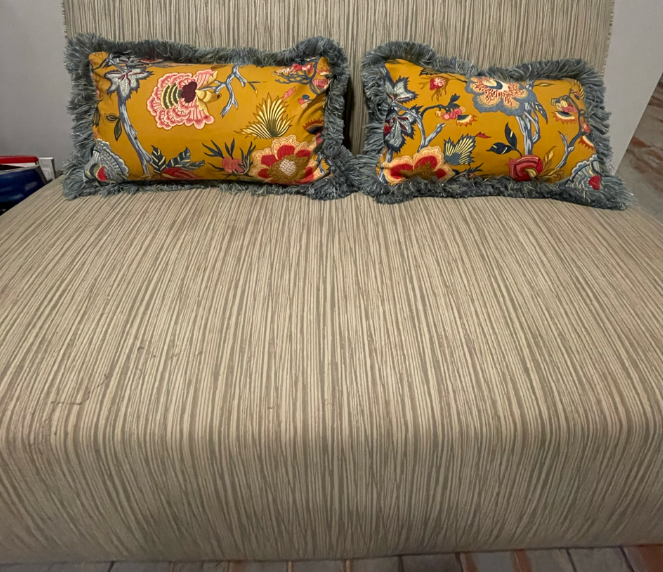
Which, now that I think about it, makes it a fairly good illustration of my point.
Eventually I knew exactly what I wanted to do with it.
I had been hoarding a gorgeous discontinued French country floral I’d found at a consignment shop in Hyde Park. I paid about $15 for it, and I had been waiting for the right piece.
This was the piece.
Today that formerly crusty free bench looks incredibly grand. More interestingly, it has changed what some of my clients choose for their own homes.
People come into the shop convinced they want a woven neutral. Then they see that banquette.
Suddenly they’re touching the floral.
Suddenly we’re pulling more patterns.
Suddenly their dining room chairs might be allowed to have a little fun.
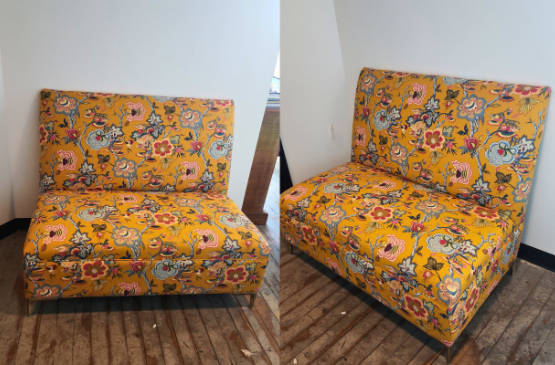
Sometimes you don’t actually know your taste until you see it in front of you.
That’s why I’d rather see someone spend a year slowly finding great things at estate sales, antique shops, consignment stores and Facebook Marketplace than order an entire house worth of furniture in one weekend.
Leave room for the weird thing.
Leave room for the thing you weren’t looking for.
Should You Reupholster It?
People ask us some version of this question constantly: Is this piece actually worth reupholstering?
There are three things I generally think about.
1. Is it sentimental?
Not all value can be found on a price tag.
Maybe it belonged to your grandmother. Maybe it’s the chair your kids remember from growing up. Maybe there’s absolutely nothing objectively remarkable about it, but you love it.
That’s enough.
Give it another life.
The wonderful thing about reupholstery is that you don’t have to preserve a piece exactly as it was to preserve what it means to you. New fabric can become the beginning of another generation of memories.
2. Is it special?
The vintage furniture market can be confusing.
You can look at a piece on 1stDibs with an enormous asking price and assume the one in your basement must be worth the same amount.
Furniture, ultimately, is worth what someone will actually pay for it.
But certain pieces absolutely deserve a closer look.
Mid-century modern furniture can be a great candidate for reupholstery, particularly well-made Danish modern pieces, interesting chrome furniture, designer pieces and anything with an unusual silhouette or construction.
Don’t let terrible upholstery distract you from a fantastic frame.
3. Is it well made?
Pick it up.
Seriously.
Older furniture can be extraordinarily heavy because underneath the upholstery there’s actual hardwood and substantial construction.
One of my favorite sofas we’ve ever restored had an extraordinary exposed wood frame. The curved portion had been created from a substantial piece of solid wood. I’d never seen anything quite like it.
The sofa was also sad.
And stinky.
And during demolition we discovered what I lovingly refer to as couch croutons.
But underneath all of that was an exceptional piece of furniture.
[IMAGE: Sofa stripped down showing the wood frame]
We rebuilt it using professional upholstery materials and gave it another life. The client also trusted me enough to have some fun with the cushions: one fabric on one side and another on the reverse.
Can’t choose between two fabrics?
Sometimes you can have it both ways.
Save the Weird Nook.
This may be my strongest argument for not furnishing your house immediately.
Leave something unsolved.
That awkward window.
The strange corner of the kitchen.
The spot underneath the stairs.
The nook where no normal piece of furniture seems quite right.
Live around it for a while.
You may discover that the useless corner doesn’t need a console table at all. It needs a built-in banquette.
That beautiful window might need a custom window-seat cushion.
That kitchen corner might become the seat everyone fights over.
Custom furniture and upholstery work best when they’re responding to the way you actually live rather than the way you imagined you’d live before you got the keys.
And I’d much rather see you save the money you would have spent filling five empty spaces with five things that are fine and eventually make one thing that’s completely, wonderfully yours.
Furniture Is Meant to Be Lived In.
Working on people’s furniture can be surprisingly personal.
Clients hand us things that have been part of their families for decades. They tell us who sat in them. Where they came from. What their kids did to them. What their cats did to them.
Then we strip those pieces down,rebuild what needs rebuilding, replace tired foam with professional-grade materials, cover them in upholstery fabric designed to withstand real use, and send them home for another chapter.
One of my favorite parts comes later.
Sometimes I get to return to a client’s home months after we’ve finished a project and see the piece being lived in.
It isn’t sitting perfectly in our shop waiting for its photograph anymore.
Someone’s curled up in it.
The grandkids are climbing on it.
Friends are gathered around the banquette.
The cat has reclaimed her spot.
That’s what furniture is for.
So yes, buy the mattress.
Unpack the wine glasses.
Invite people over before everything is ready.
But don’t be in such a rush to fill every corner.
Let an empty nook stay empty for a little while. Go to the estate sale. Save the old chair. Pull over when you see the handwritten sign. Buy the ridiculous floral. Refinish an old memory and make some new ones on top of it.
Have a vision.
Just don’t force that vision on the house.